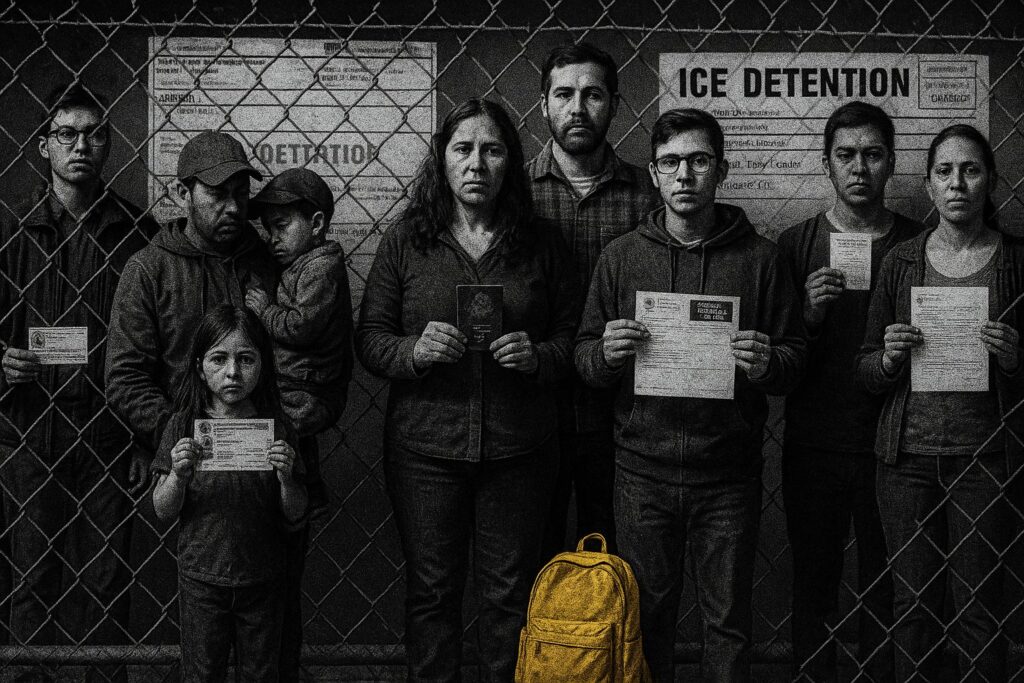
The New Face of ICE Detention: When Innocence Isn’t Enough
It used to be widely assumed — by policymakers, the public, and even many media outlets — that immigration enforcement mostly targeted dangerous criminals. But fresh data reveal a stark, chilling reality: immigrants with no criminal record are now the largest group held in ICE detention. This shift is not an oversight. It reflects a recalibration of priorities toward mass punitive enforcement — and a wholesale betrayal of justice, decency, and human rights.
Don’t risk your case with unverified services. We’ll match you with a licensed immigration lawyer or accredited representative.
Find My Lawyer →Free case matching. No obligations. Only verified professionals.
The Numbers Don’t Lie: Innocents Behind Bars
16,523People in ICE custody with no criminal record
15,725 – Immigrants with criminal convictions
13,767 – Immigrants with pending charges
In the total population of 59,762 detained in immigration custody, the scale of non-criminal detention marks a historic turning point. – The Guardian
This is not a small, marginal phenomenon. Under the current Trump administration, the number of non-criminal detainees has surged. ICE’s numbers now contradict the foundational claim often pressed by hardline immigration rhetoric: that the system is focused on “bad actors.” – The Guardian
“These are hardworking people. These are not criminals.”
– A former civil rights official in DHS, – The Guardian
Legal Reality Check: Being undocumented is not a criminal act under U.S. law, but a civil violation. Yet in practice, many detained fall into that very category.
From Enforcement to Expedience: How the Shift Happened
This dramatic reversal didn’t occur by chance. The forces behind it are deliberate, institutional, and political.
Mandates to “Ramp Up” Arrests
Federal directives have pushed ICE to drastically increase its arrest quotas — aiming for 3,000 arrests per day (or over one million per year). That sort of volume demands casting a wider net, often indiscriminately. Rather than focusing on serious criminals or genuine national security threats, the system sweeps up immigrants with no record, who pose no danger to communities.
Collateral Arrests
In many cases, ICE arrives with a warrant for one person — but ends up detaining others on the scene, who may not even be the target of the operation. These so-called “collateral arrests” expand the dragnet indiscriminately. People with clean histories, stable lives, families, and deep roots in the U.S. find themselves detained in the name of broader enforcement goals.
Need help choosing an Immigration Lawyer?
We’ll connect you with a verified immigration lawyer who fits your case and location.
Start Free Case Review →Agency Collaboration and Expansion
ICE’s “arsenal” now includes support from other federal agencies — the FBI, DEA, Homeland Security Investigations — and partnerships with local police and sheriffs, some deputized for immigration tasks. Even state and local agencies have, in some cases, become complicit in raids and detentions. This wide net ensures the system doesn’t just target high-risk individuals, but sweeps entire communities into fear and uncertainty.
The Cost: Lives in Limbo, Families Torn, Communities Fearful
Psychological and Physical Hardship
Being detained in ICE custody is rarely benign. Reports have long documented overcrowding, lack of proper medical care, poor sanitation, and mental health crises. When you combine that with the trauma of being held without having done any crime, the damage is multiplied.
Family Separation
Many non-criminal detainees are deeply integrated into U.S. life. They have U.S.-citizen children, spouses, aging parents, or are primary household providers. Their detention imperils the stability of whole families, forcing children into economic or emotional precarity. Some may never recover the security they had.
Eroded Trust in Institutions
If a person can be detained without wrongdoing — merely for their status — trust in the justice system, law enforcement, and government weakens. Immigrant communities respond by withdrawing from civic life: fewer calls to police, less engagement in public services, and deeper isolation. Public safety suffers, not improves.
Resource Drain
Mass detention of non-criminals is expensive. It burdens the U.S. budget, courts, and bureaucratic capacity. When so many resources are funneled into detaining innocents, less is left for policing actual crime, social services, and community support. The worst irony: we sacrifice safety for the sake of spectacle.
Pushback, Resistance, and Paths Forward
This moment demands more than outrage — it requires organizing, legal challenge, and moral clarity.
Demand Transparency & Accountability
If ICE is expanding detention to the non-criminal, the public has a right to know how, why, and under whose authority. Oversight mechanisms must demand full disclosure.
Litigation is Key
Legal challenges that question the expansion of detention beyond statutory authority must be bolstered. Courts are among the last lines of defense.
Reaffirm Legal Norms
We must push the narrative that immigration status is not equated with criminality. That distinction must be reinforced, legally and culturally.
Build Solidarity Networks
Nonprofits, legal aid groups, and community organizers must expand their reach into impacted communities. Document stories, provide representation, mobilize pressure.
Conclusion: The Face of Injustice Has Changed
The news that non-criminals now form the majority within ICE detention is not a trivial shift in statistics — it’s a moral alarm. It shows that the system, under this administration, has abandoned restraint, discretion, and humanity in favor of fear and mass punishment.
For the communities targeted, the impact is real, immediate, and devastating. For concerned citizens, it must be a clarion call: to expose, resist, and reclaim dignity.
Let this moment galvanize us to uproot narratives of criminality, to defend rights regardless of race or status, and to demand that our immigration system — and our country — be led by justice, not vengeance.
Find a Verified Immigration Lawyer Near You
Avoid scams. Get help from licensed professionals who understand your case.
Get Matched Now →Free case evaluation. We are not a law firm — we connect you with trusted, verified lawyers.