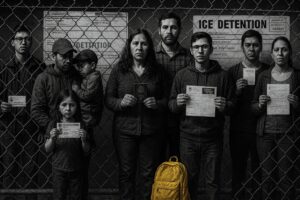
In Franklin Park, Illinois, a quiet traffic stop turned into a deadly encounter that has left an immigrant community shaken, lawmakers demanding answers, and a family mourning a loss many believe could have been avoided.
Don’t risk your case with unverified services. We’ll match you with a licensed immigration lawyer or accredited representative.
Find My Lawyer →Free case matching. No obligations. Only verified professionals.
What Happened That Day
On the morning of September 12, 2025, U.S. Immigration and Customs Enforcement (ICE) agents were conducting an operation in Franklin Park, a suburb near Chicago. According to the Department of Homeland Security (DHS), 38-year-old Silverio Villegas-Gonzalez, a Mexican national, was driving when agents attempted to pull him over. DHS says he resisted arrest, tried to flee, and drove his vehicle toward the agents, dragging one officer and forcing another to open fire.
The official report states that the ICE officer was “seriously injured” and hospitalized but later released in stable condition. Villegas-Gonzalez died soon after the shooting, reportedly after crashing into a delivery truck.
That was the version the public first heard — a violent confrontation that left one man dead and an officer hurt. But within days, new evidence began to surface, and the story started to look less certain.
Conflicting Footage and Witness Accounts
Surveillance footage from nearby businesses and police body-camera videos released later do not clearly show Villegas-Gonzalez driving directly at the agents. Some witnesses said the situation appeared chaotic but did not see him attempt to strike anyone with his car.
In one police video taken moments after the shooting, an ICE officer describes his injuries as “nothing major,” mentioning only a sore knee and a few cuts. This has caused some observers to question whether the officer was indeed “seriously injured,” as DHS initially claimed.
Human Rights Watch and several civil-rights groups have called for an independent investigation, saying the government’s narrative may not match what actually happened. The Illinois Governor’s Office and several members of Congress from the state have also urged federal officials to release all available video footage and evidence to the public.
The Department of Homeland Security has defended its agent, calling some of the criticism “smears” and insisting that the officer acted in self-defense. The department also stated that Villegas-Gonzalez had a “history of reckless driving,” though details about those incidents remain unclear.
Why the Case Matters
The shooting of Silverio Villegas-Gonzalez is not just about one tragic event. It highlights ongoing tensions between federal immigration enforcement and local communities, especially in states like Illinois, which have tried to limit ICE’s involvement in local policing.
Advocates argue that ICE should not have been conducting what looked like a traffic stop in the first place. Normally, immigration officers enforce federal immigration law — not local traffic laws — unless there’s an immediate link to a criminal or immigration violation. Critics say this blurring of roles creates confusion and danger for both immigrants and officers.
For many residents, the tragedy also reignited fears about immigration raids and deportations. People living in mixed-status families — where some members are U.S. citizens and others are not — say they feel less safe now, worried that a simple stop could turn deadly.
The Human Story Behind the Headlines
In the small town where Silverio Villegas-Gonzalez was born in Mexico, and in the Chicago suburb where he lived, people have been holding vigils, sharing stories, and demanding accountability.
Friends and relatives describe him as a hardworking father who supported his family and stayed out of trouble. “He just wanted a better life for his kids,” one neighbor told a Chicago radio station.
His death has become a symbol of what many call the human cost of aggressive immigration enforcement. “No traffic violation should ever amount to a death sentence,” said one Illinois lawmaker during a recent rally.
The Mexican Consulate in Chicago has offered support to the family and formally requested a transparent investigation. They are helping return his remains to his hometown, where friends plan a final memorial service.
Need help choosing an Immigration Lawyer?
We’ll connect you with a verified immigration lawyer who fits your case and location.
Start Free Case Review →A Pattern or an Exception?
This incident has brought national attention to how ICE operates in local communities. ICE officers have the authority to detain individuals suspected of immigration violations, but they often coordinate with local police or conduct “targeted operations.” Critics argue these operations can resemble traditional policing — something federal agencies are not meant to do.
Past reports have shown that ICE sometimes relies on unmarked vehicles, plain-clothes officers, and quick stops, which can lead to confusion or escalation. Supporters of ICE say these tactics are necessary because officers often face unpredictable situations, and suspects sometimes flee or fight back.
But others believe the system lacks sufficient oversight. In 2022, Illinois reached an agreement with federal agencies meant to limit ICE’s power to perform warrantless arrests or traffic stops in the state. If that agreement was still active, it raises questions about whether ICE followed it during the Franklin Park incident.
Reactions From Officials and Communities
State and local leaders have reacted strongly. Governor J.B. Pritzker called for “full transparency and accountability.” Members of the Illinois congressional delegation demanded the immediate release of all footage and records. Several city council members in Chicago and nearby towns have expressed support for new legislation to restrict federal immigration enforcement within city limits.
Advocacy organizations such as Human Rights Watch, the Illinois Coalition for Immigrant and Refugee Rights, and the Chicago Coalition to End Homelessness have also issued statements condemning the shooting and urging reforms.
Meanwhile, ICE and DHS continue to defend the officer’s actions, emphasizing that agents are often placed in dangerous situations and must make split-second decisions.
A Broader Question of Trust
The death of Silverio Villegas-Gonzalez has deepened a long-standing divide between immigrant communities and federal law enforcement. To many immigrants, the message is clear: even in a “sanctuary state” like Illinois, encounters with ICE can turn deadly.
To ICE officers and supporters, the incident shows how quickly routine enforcement can become dangerous, especially when suspects resist or flee. They argue that critics overlook the risks agents take every day.
Between those two views lies a growing question about trust. If immigrant families believe that federal officers cannot be trusted to act fairly or safely, cooperation will break down. That lack of trust can make both enforcement and community safety harder to achieve.
What Happens Next
As of early October 2025, federal and state authorities are reviewing the case. The DHS Office of Inspector General is expected to conduct an internal investigation, while civil-rights groups are pressing for an outside inquiry. There has been no official announcement of charges or disciplinary action against the ICE officer involved.
Whatever the outcome, the case is likely to shape how ICE operations are viewed in the coming months. It could influence how states design “sanctuary” policies, how local police cooperate with federal agents, and how communities across the country respond when enforcement leads to loss of life.
A Moment to Reflect
No matter where one stands on immigration policy, the death of Silverio Villegas-Gonzalez is a tragedy that deserves honest reflection. It forces us to ask difficult questions:
- When should federal agents use deadly force?
- How much transparency should the public expect when something goes wrong?
- And how can law enforcement keep communities safe without turning ordinary encounters into fatal ones?
As lawmakers, activists, and federal officials continue to argue over what happened and why, one thing remains certain: a family has lost a father, a community has lost trust, and the nation is again forced to look closely at how justice and immigration meet on American streets.
Find a Verified Immigration Lawyer Near You
Avoid scams. Get help from licensed professionals who understand your case.
Get Matched Now →Free case evaluation. We are not a law firm — we connect you with trusted, verified lawyers.