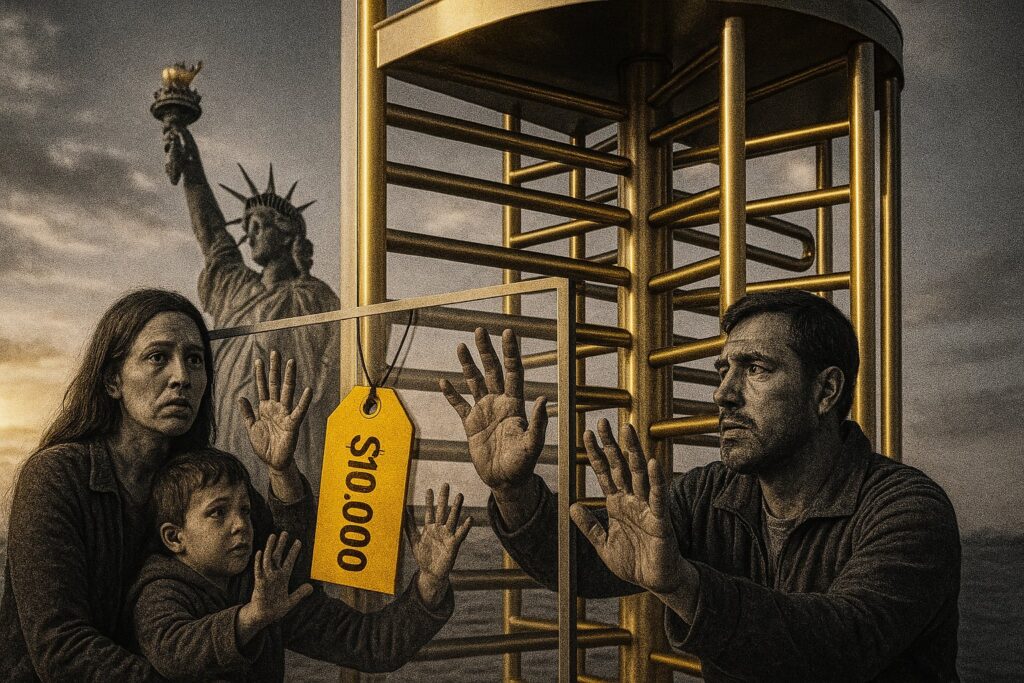
In a system already rife with obstacles, the Trump administration has added a cruel new barrier: overwhelming fees for those seeking refuge in the United States. These are not reasonable administrative costs — they are deliberate gates, designed to filter out the very people whom the law says this country must protect.
Don’t risk your case with unverified services. We’ll match you with a licensed immigration lawyer or accredited representative.
Find My Lawyer →Free case matching. No obligations. Only verified professionals.
One asylum-seeker, detained in the U.S. for nearly nine months, sat before an immigration judge ready to tell her story. She had evidence, witnesses, and the moral claim of persecution. But the judge demanded she pay a $100 asylum application fee — even though legally she shouldn’t have to. Without paying, her hearing was refused. The result: she was forced to return to a region where violence stalks everyday life.
This is not a one-off injustice. It’s a systemic crackdown on access to justice, wrapped in the guise of fiscal reform. A Surge of Fees: From
Entry to Appeal, Everything Costs
Under a sweeping legislative package signed by President Trump, dozens of new and elevated fees now block paths that were once modest or free.
Among the worst changes:
Asylum applicants must now pay $100 up front, plus another $100 for each year the case drags on (and immigration courts currently face a backlog of 3.75 million cases). Requests to appeal decisions or reopen closed cases can cost more than $1,000. Temporary Protected Status (TPS) applications — once priced modestly — now require fees exceeding $500, up from $80. Work authorization, which was once free or easily accessible for asylum seekers, now carries a $550 fee, with no waiver option. Even children classified as abused, neglected, or abandoned must pay hundreds of dollars for special status classifications. These are not incidental costs. For many asylum seekers — who arrive with little to nothing — such fees are insurmountable.
A Justice System for Sale, Not for the Persecuted
What message does charging $100 just to be heard send? That justice is no longer a right — it’s a transaction. For survivors of violence, persecution, and torture, such fees are not gentle hurdles; they are death sentences. One lawyer observed that the fees are being assigned “when it’s impossible to fulfill.”
In practice, these costs filter out the poorest, silencing those who cannot pay. That turns federal asylum courts into citadels, reachable only by those with means — contradictory to the principle that asylum is a refuge for those fleeing danger, regardless of wealth.
Even when the government later introduced an online portal for payments, it came too late for many already denied their day in court. For those detained or without resources, the portal is little more than window dressing.
– The Guardian
Legal advocates have said this is not coincidental. These fees are designed to extinguish access, to turn the system into a fortress. “They really want to … push people out … not have people meaningfully be able to participate in these proceedings,” according to a deputy attorney in New York.
Need help choosing an Immigration Lawyer?
We’ll connect you with a verified immigration lawyer who fits your case and location.
Start Free Case Review →The Human Toll: Dreams Deferred, Families Crushed
Behind the statistics lie human tragedies — families shattered, lives suspended, hope extinguished.
Consider Yajaera and her family, who fled persecution in Nicaragua. After months without legal status or work, the family discovered the new $550 work permit fee applied to each person — a sum totaling $2,200 just to file. With no savings and no steady income, they are trapped. These are typical stories: people escaping violence, arriving with near nothing, and then being asked to pay exorbitant sums just to be heard. If they refuse or fail, their applications are rejected outright, regardless of merit. For many, it’s a choice between paying or returning to danger. It’s not a choice at all.
Intentional Barriers: Policy, Not Oversight
These new fees are not bureaucratic missteps. They follow a recognizable pattern in the administration’s immigration strategy: erecting insurmountable gatekeeping mechanisms. The goal is clear — reduce the number of asylum claims by making them financially unviable.
In effect, the administration is turning legal paths into traps. Those who try to preserve their status are confronted with opaque rules and impossible demands; those who don’t, risk deportation. Either way, the system becomes exclusionary by design.
The backlog of 3.75 million cases in immigration courts only exacerbates the barrier. An asylum seeker may face years — and repeated payments — before their case advances. Each year, another $100. It’s debt by attrition.
Fee structures like these are common barriers in voting, civil justice, and education — weaponized to suppress access. Using them in immigration justice is no different.
What Must Be Done: Reclaiming Access to Asylum
- Repeal or Restrict These Fees Immediately
Congress must act to roll back the new fees and restore waivers. If asylum is a right under international and domestic law, access must not depend on wealth. - Mandate Fee Waivers for the Impoverished
Where fees remain necessary, waivers should be automatic for applicants who can’t pay. Judges should not reject cases for nonpayment if waiver eligibility is not considered. - Increase Oversight and Transparency
Courts and agencies must publish data on denial rates tied to nonpayment, backlog delays, and fee impacts. That data is critical for judicial and legislative scrutiny. - Legal Challenges Must Follow
Constitutional and statutory challenges to these fees — under equal protection, due process, and administrative law — should be accelerated. The courts must check this expansion of financial exclusion. - Public Awareness and Advocacy
Immigrant-rights advocates and media must shine light on individual stories. The public must see that these are not faceless cases — they are parents, children, survivors of violence, and people seeking safety.
Conclusion: When Rights Become Pay-to-Play
When asylum seekers must pay up front for the right to present their case, the U.S. loses its claim to being a refuge for persecuted people. High fees don’t weed out meritless claims — they weed out poverty.
For many who flee violence, the journey is already a gamble. Charging asylum seekers thousands in fees is the administration’s way of making that gamble fatal. But we must resist. BorderWire readers, this is not a matter of bureaucratic fine-tuning — this is moral urgency.
We must demand that gates be torn down, not strengthened. Justice must be restored — not sold. The U.S. cannot continue to shape its asylum system into a fortress accessible only to the well-off. Our laws, our values, and our conscience demand better.
Find a Verified Immigration Lawyer Near You
Avoid scams. Get help from licensed professionals who understand your case.
Get Matched Now →Free case evaluation. We are not a law firm — we connect you with trusted, verified lawyers.